 kiduverse
Sink the hidden fleet before your opponent finds yours.
Battleship is a game of incomplete information. You see your own fleet and the clues your shots reveal about the other board. Each shot gets one answer: miss, hit or sunk. Those small clues gradually turn an empty chart into a map of the enemy fleet.
- Two sides
- One 10×10 board each
- Ten ships
- Twenty occupied cells
- A hit earns a shot
- A miss passes the turn
You can open the separate play page against the computer, or use the same rules for a paper match. Each player draws two charts: one for their own ships, one for what they discover about the opponent. Keep your paper hidden and record every shot. Clear records prevent most disagreements.
This guide covers the board, fleet, placement, shot results and difficult situations. It also includes three complete fleet layouts and six worked positions. The browser game follows the rules described here; optional home rules are identified separately.
Open the game, then return to the diagrams whenever you want to check a rule.
Battleship rules in one minute
- Each side secretly places ten ships on a 10×10 board.
- Choose who fires first. In this browser game, you do.
- Choose a coordinate, such as B4, on the opponent’s chart.
- Record the answer: miss, hit or sunk.
- A hit gives another shot; a miss passes the turn.
- Sink every ship in the other fleet to win.
Play Battleship against the computer
Both fleets are placed randomly using the no-touching rules. Fire into the opponent’s waters. The computer searches using a checkerboard pattern and follows up a hit along the ship’s line. Before its shot, an aiming marker shows the target on your board. It uses shot results, not the locations of your unhit ships.
Open the game →How to play together on paper
Each player works on their own sheet, with two charts. The opponent never sees the ships during the match; information is shared through spoken coordinates and honest answers. Letters and row numbers must mean the same thing for both players.
Your fleet chart
Your search chart
A complete paper turn
- Draw two 10×10 charts and label columns A–J and rows 1–10.
- Place the full fleet on one chart and hide it from your opponent.
- Toss a coin to choose who fires first.
- The shooter names a cell and marks the reply on their search chart.
- The fleet owner checks their ship chart, reports miss, hit or sunk, and records the incoming shot.
- Keep shooting after a hit; pass the turn after a miss.
- End when one fleet is entirely sunk, then show the fleets to check placement.
Both players record every shot: the shooter on the search chart, the fleet owner on the ship chart. Without both records, a disputed turn is difficult to reconstruct.
The 10×10 board and coordinates
Columns run from left to right and rows from top to bottom. Read a coordinate as a letter followed by a number: A1 is the top-left cell and J10 the bottom-right. The Russian version uses А, Б, В, Г, Д, Е, Ж, З, И, К. For a paper match, any consistent set of labels works if both players agree.
Read the letter first
G2 is column seven, row two. C7 is column three, row seven. Check the column at the top, then trace down to the row label.
In the browser game, checked cells cannot be fired at again and do not cost a turn. On paper, agree in advance whether a repeated coordinate simply repeats the answer or uses up the shot.
The fleet: ship sizes and placement
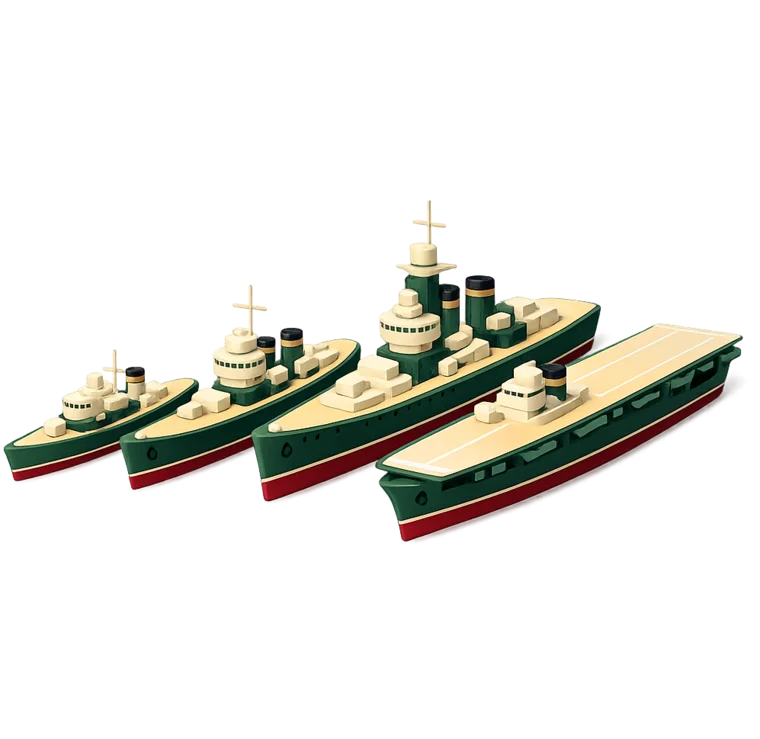
A ship is a straight horizontal or vertical line. It cannot bend, run diagonally or have a gap between its cells. Every fleet has ten ships occupying twenty cells.
| Ship length | Number of ships | Occupied cells |
|---|---|---|
| Four | 1 | 4 |
| Three | 2 | 6 |
| Two | 3 | 6 |
| One | 4 | 4 |
| Total | 10 | 20 |
Twenty of the hundred cells contain ships. A uniformly random first shot therefore has a one-in-five chance of a hit on a fixed fleet. Later shots should use the information already revealed rather than treating every cell as equally useful.
The no-touching rule
Different ships cannot touch along a side or at a corner. Leave an empty-cell border around each ship. This border is why water around a sunk ship can be excluded without firing into it.
Imagine a one-cell frame around a ship. No other ship cell can be inside it. Two frames may overlap on empty water; that does not make the placement illegal.
Three complete fleet layouts
Each layout below has the full ten-ship fleet with twenty occupied cells and no touching. They are legal examples, not guaranteed winning arrangements. In the browser game the fleet is random; use these layouts for a paper match or to practice checking placements.
Shots: miss, hit and sunk
- Miss
- The cell is water. Mark a dot and pass the turn.
- Hit
- A ship cell is damaged but another cell in that ship remains intact. Mark a cross and fire again.
- Sunk
- The last intact cell in that ship has been hit. Mark the entire wreck and continue shooting.
Why mark the water around a wreck?
No other ship can touch the sunk ship, so those surrounding cells are known water. Mark them immediately on paper to avoid wasting shots. The browser does this for you. A four-cell ship away from the edges can have fourteen surrounding water cells; near an edge the border is smaller.
Difficult situations and the end of the game
| Situation | What to do |
|---|---|
| A repeated coordinate | Blocked in the browser. On paper, follow the rule agreed before play. |
| A coordinate outside the board | Correct the coordinate before counting a shot. |
| A hit reported as a miss | Use both records to restore the position and replay the disputed turn. |
| Extra or illegally placed ships | A paper match needs an agreed penalty or replay. Browser fleets are validated automatically. |
| Both players used illegal fleets | Agree on a replay rather than pretending the recorded result is reliable. |
| The final ship is sunk | The shooter wins immediately. |
Ordinary play has no equalizing shot: one side’s fleet is sunk first. Paper players should show their fleet after the game so both can check that the hidden placement followed the agreed rules.
Six worked positions: where to fire and why
The left diagram shows what is known; the right shows a possible continuation or the water that can be excluded.
The ship’s direction is unknown. Check above, below, left or right. A diagonal cell cannot continue this straight ship.
These neighbouring hits belong to a horizontal ship. Continue left or right. Cells above or below cannot be part of that ship.
The left end is already water. If the ship is not sunk, its only possible continuation is to the right.
The three-cell wreck has twelve surrounding cells in this interior position. They are water because different ships cannot touch.
A straight two-cell ship crosses both colours, so it cannot avoid a search covering one colour. Single-cell ships still require checking skipped cells.
Three unchecked cells can hold a three-cell ship. A four-cell ship cannot fit here. The useful search depends on what remains in the fleet.
A better search plan

- Search for long ships where they fit. A four-cell ship needs four consecutive unchecked cells. Do not use a narrow pocket to search for it.
- Use a checkerboard pattern. Every straight ship of length two or more covers both colours, so one colour is enough to encounter each such ship. Single-cell ships are the exception.
- Finish a damaged ship. Start with the four side neighbours of the first hit. Once a second hit reveals direction, follow the line rather than unrelated cells.
- Keep the chart tidy. Record misses and exclude borders as soon as ships sink. Memory is a poor substitute for marks.
- Count the remaining fleet. When the long ships are gone, change your search to include small pockets and the skipped colour.
- Vary paper placements. Use different orientations and areas rather than a predictable cluster. Scattered single-cell ships can be difficult to finish finding.
There is no guaranteed winning layout. Luck affects both players. The useful improvement is making fewer shots into cells that are already known water or cannot contain the ship you are searching for.
Simple to follow, but it ignores the geometry of long ships and checks both colours too early.
Covers every length-two-or-longer ship with fewer search cells, then uses hits to finish it. Switch to the remaining cells for singles.
Home and regional variants
Agree on variants before a paper match. They change what a legal fleet or turn means. The interactive game follows the middle column below and does not switch rules during play.
| Rule | This game | Possible home variant |
|---|---|---|
| Diagonal touching | Forbidden | Allowed, with side touching still forbidden |
| After a hit | Shoot again | Always alternate turns |
| Fleet | 4–3–3–2–2–2–1–1–1–1 | Different numbers and lengths |
| Shape | Straight lines | Bent ships, with agreed placement rules |
Test your plan in the next match
Choose a search order before firing. After the first hit, name the four possible neighbours. After the second, explain the ship’s direction. Before every follow-up shot, say why that cell could still contain a ship.
After the match, review decisions rather than only the score. Did you abandon a damaged ship, forget an excluded border or search for single-cell ships too early? Pick one mistake to repair in the next game and try the technique without help.
Play another matchFrequently asked questions
Can I play Battleship here?
Yes. Play the computer on its separate play page for free, without signing up or installing an app. Corners is also available if you want a game with an entirely visible board.
Do I place the ships myself?
Both fleets are placed randomly using the classic no-touching rules. New fleet starts a fresh game with different positions.
How does the computer choose shots?
It searches cells of one checkerboard colour, follows up hits along the ship’s line and excludes water around sunk ships. It chooses using shot results rather than reading your hidden ships.
How big is the board?
Ten columns by ten rows. Letters label the columns and numbers label the rows. This English version uses A through J: A1 is the top-left cell.
How many ships does each player have?
Ten ships: one length-four, two length-three, three length-two and four single-cell ships. Together they occupy twenty cells.
Can ships touch?
Not in this version. Different ships must have at least one empty cell between them, including diagonally.
Can a ship be diagonal or bent?
No. Every ship is a straight, unbroken horizontal or vertical line. L-shaped, diagonal or disconnected ships are not allowed.
What happens after a hit?
A hit or a sunk ship gives the shooter another shot. A miss passes the turn. On paper, the owner of the fleet reports miss, hit or sunk.
Must I mark water around a sunk ship?
On paper this is a useful habit rather than another shot: no ship can touch the wreck. The browser game marks those cells automatically.
Can the game end in a draw?
Ordinary play ends as soon as one fleet is sunk. Paper players can agree on a replay or draw if both fleets broke the placement rules.
Who shoots first?
You shoot first on Kiduverse. For a paper match, toss a coin or agree on another fair way to choose.
Are these the only Battleship rules?
No. Paper and published sets vary in fleet sizes, touching rules and whether a hit gives another shot. The browser game follows the version described here.