 kiduverse
Quick rules
Four in a row is a two-player line-building game on a board with seven columns and six rows. Each side has a counter colour. Choose a column and drop one counter into it. Gravity carries the counter to the lowest empty space in that column. Connect four of your colour horizontally, vertically or diagonally to win.
Choose Computer or Two players here. Against the computer you control coral counters and it controls blue counters. The First move selector decides which colour starts. Computer levels change its decisions, not the board size or the winning rule. In the two-player mode both sides share the device.
- Check whether a legal drop wins immediately.
- Look for an immediate winning drop for the other colour.
- Choose a column with an open space.
- Wait for the next side and continue until a line or a full-board draw.
A move selects a column, not an arbitrary hole. This is the main difference from games where you can place a mark in any empty square.
The rack, colours and gravity
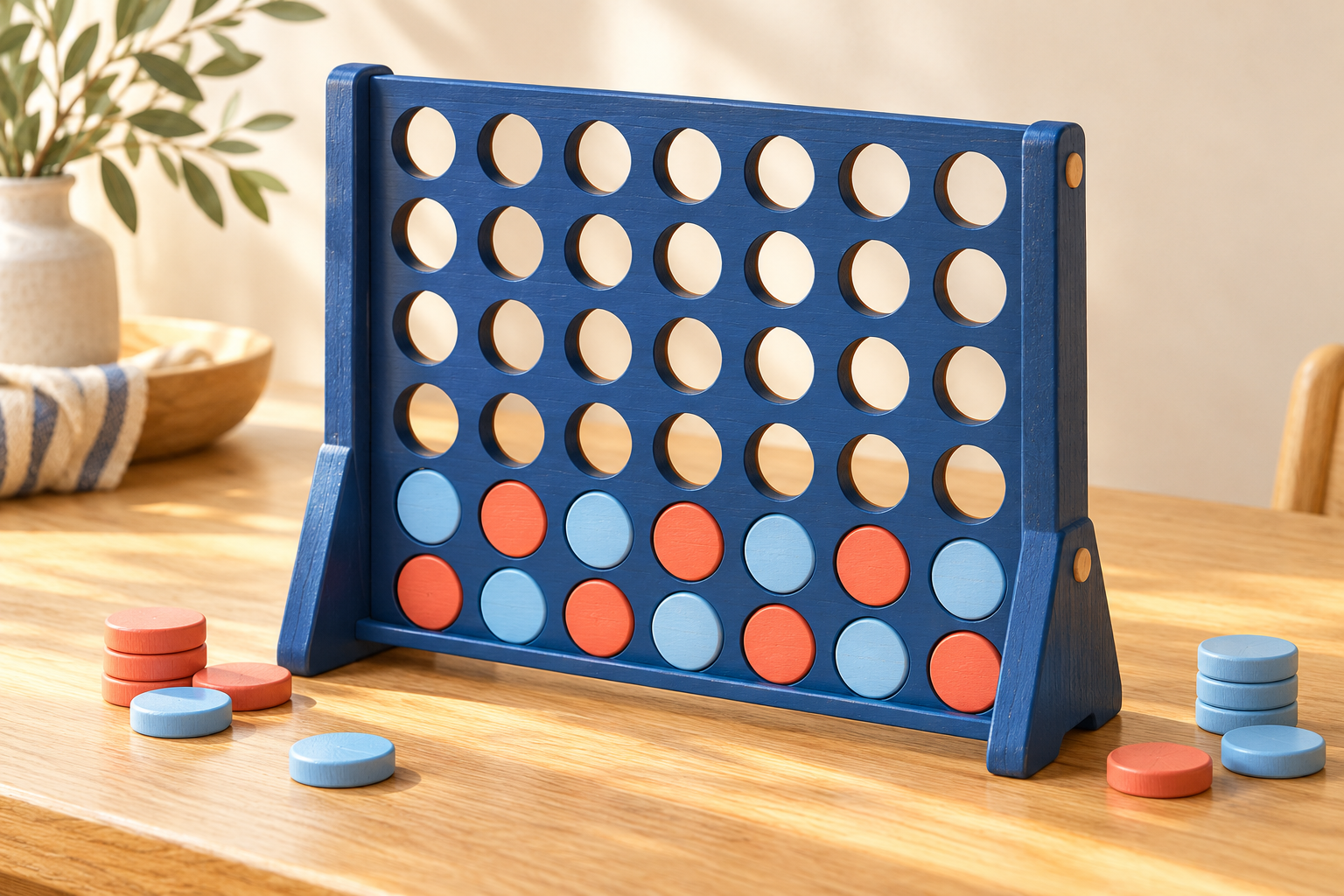
The board has forty-two spaces. Columns run left to right; the diagram coordinates use A through G. Rows are numbered from the top, so the bottom row is row 6. The first counter in an empty column lands on that bottom row. The second rests directly above it, regardless of its colour.
Coral and blue counters stay visible throughout the match. There is no hidden hand or secret location. The arrows above the rack choose columns. The counters in the board show the current stack; they are not draggable pieces. A full column cannot accept another counter and its arrow becomes unavailable.
The illustrated bottom row contains coral in A6, B6 and C6, blue in F6 and G6, and another blue above G6. It is coral's turn. A drop in D fills D6 and completes a horizontal line. The empty spaces above A6 are not alternate landing places for the same move: a counter must rest on the current stack.
Legal drops and unreachable holes
You may drop into any column that is not full. You cannot remove a counter, change its colour, move it sideways or hold it in a higher hole. A diagonal winning line obeys the same gravity rule; every counter in that diagonal must have support beneath it from the bottom of the rack or another counter.
An empty square can be part of a future threat without being playable now. Suppose a colour needs a hole on row 4, but rows 5 and 6 beneath it are empty. A drop will land on row 6, not the desired row 4. Count the missing supports before calling that square an immediate winning move.
The browser ignores actions during the computer's response and stops accepting moves after a result. It also rejects a full column. There is no undo button for this game. Use New match if you want a fresh opening; on paper or a physical rack, any agreement about taking a move back should be made before play begins.
Winning and full-board draws
Four touching counters of one colour in a straight line end the match. Lines may be horizontal, vertical or diagonal in either direction. A longer line also contains a winning four. Bent shapes, separated counters and a diagonal with a gap do not count. A single last counter may complete more than one line; the game still has one winner.
The winning four are highlighted. Play stops immediately, even when most of the rack is empty. Only if all forty-two spaces are filled without a winning line does the match end in a draw. Filling one column or having no move in your favourite column is not a draw while another column remains available.
The starter can be changed for the next match. Across a series, alternate colours or the starting side. Changing the computer level, mode or starter begins a fresh board rather than altering the current opponent mid-position. A pending computer turn is cancelled when the match restarts.
Three positions to think through
Complete your own line. In the bottom-row example, coral can win by dropping in column D. The counter lands at D6 beside A6, B6 and C6. Check your immediate victory before considering a defensive move elsewhere: once the line is completed there is no blue reply.
Block a playable threat. Imagine blue counters at the bottom of A, B and C, with D6 empty. If coral cannot win immediately, a drop in D blocks that blue row. Notice that E6 is not the right defence: it leaves D6 available and the four contiguous blue spaces can still be completed.
Inspect a vertical stack. Blue has three counters one above another in column G, with the next hole empty. A coral drop into G lands directly on the stack and blocks a vertical fourth. A blue pair on a distant diagonal may look interesting, but this accessible fourth is the immediate threat to address first.
When looking at a diagonal, trace both its colour and the empty landing square. A beautiful-looking diagonal near the top of the rack is not necessarily a one-move threat.
A practical strategy
Use the order: win now, block an immediate loss, then build a position with useful future drops. The central columns participate in more potential lines than the outside columns, so a centre opening often gives flexible options. Still, choosing the centre automatically is wrong when a different column wins or blocks a loss now.
Before a drop, mentally add your counter at its actual landing height. Ask whether the new stack gives the opponent a playable winning hole directly above your counter. Sometimes placing a support is exactly what makes a previously unreachable threat become available.
Look for two different winning drops on your next turn. A double threat is strong because the other colour can normally fill only one column. But check that both landing squares are genuinely available, and that the opponent does not already have its own immediate win. Two distant sets of three are not enough without playable endings.
Easy chooses legal columns without planning. Medium looks for wins, blocks and shorter continuations. Hard searches deeper and evaluates possible lines; it is stronger assistance for practice, not a claim of perfect play or a measured human rating.
Home rules and related games
A physical rack uses the same gravity idea. For a paper version, draw seven columns and six rows, then mark the lowest empty square in the chosen column on each turn. Do not simply draw a mark in a high space. Keep the colours or marks different and inspect all four line directions after every drop.
A cooperative teaching game lets both players name the landing square before a move. Another variation pauses after each pair of turns to identify the nearest playable threat. These pauses are home practice rules, not additional browser modes. Agree on a starting side and whether an accidental choice may be replayed.
Versions that let you remove bottom counters, pop pieces out or use a larger board have different consequences. This page implements ordinary dropping on a fixed 7×6 board. The colour scheme is Kiduverse's own. The guide does not import another product's artwork or promise variants that are absent from the game.
An independent blocking challenge
In the practice diagram blue occupies A6, B6 and C6. Coral occupies E6 and F6. It is coral's turn. Which column prevents blue from winning on its next drop? Explain where your counter actually lands, then name the four squares blue would occupy if you ignored the threat.
Make a new paper position with a vertical threat instead. Add three blue counters at the bottom of a column and enough legal coral turns elsewhere to make the move count consistent. Keep the threat's next landing square empty. Identify the coral defence without copying the original horizontal example.
Open the browser game on Medium and, before each drop, name its landing height and check the opponent's immediate answer. The first challenge's defence is column D: coral lands on D6 and breaks the blue row. If your game ends quickly, revisit the final two drops and ask which available square completed the line.
Browser and keyboard controls
Use the arrow above a column to drop a counter. On a phone, tap that arrow. Keyboard users can Tab to the seven column controls, move between them with Left or Right and activate a legal drop with Enter or Space. Filled columns are unavailable; readable cell labels still describe the visible board for assistive technology.
A short computer-thinking status separates turns. New match works during that pause and cancels the old reply. The most recent counter has a brief arrival animation, while the completed winning line has a persistent highlight. Reduced-motion settings remove the drop animation without changing the rules.
JavaScript is needed for the match. The full guide and diagrams remain readable without it. The activity is free and requires no registration, installation or remote matchmaking. It does not save the board when you leave. For a smaller line-building game try tic-tac-toe, where placing a mark anywhere empty removes the gravity constraint.
Open the game →Frequently asked questions
How large is the board?
Seven columns and six rows, with 42 spaces. Each move drops one counter into the lowest open space of a column.
Do diagonals count as a win?
Yes. Four touching counters of one colour win horizontally, vertically or along either diagonal.
Can I place a counter in any empty hole?
No. Choose a column; gravity determines the landing square. Counters cannot float above an empty space.
Can two players share a device?
Yes. Choose Two players here. Players take turns with coral and blue counters on the same device.
How do computer levels differ?
Easy chooses a legal column without planning. Medium checks tactics and shorter continuations. Hard searches more deeply; it is not presented as perfect play.
When is the game a draw?
When all 42 spaces are occupied and neither colour has a line of four. A single full column is not a draw.
Can I remove or undo a counter?
No. This version uses ordinary drops only. Start a new match to clear the board.
Does restarting cancel a computer reply?
Yes. A pending reply is cancelled, and the new match starts with the selected first colour.