 kiduverse
Quick rules
Fruit sudoku is a picture version of a logic puzzle. Fill every empty square so that each fruit appears exactly once in each row, each column and each outlined box. A 4×4 puzzle uses four fruits and four 2×2 boxes. A 6×6 puzzle uses six fruits and six rectangular 2×3 boxes. You do not add fruit values or do arithmetic.
Start with the 4×4 Easy board. The green-tinted squares are given clues and cannot be changed. Select an editable cell, then choose a fruit from the tray. Use the fruit's shape as well as its colour: the red apple and the red strawberry are different symbols. Numbers can replace the pictures without changing the puzzle.
- Inspect the selected cell's row, column and box.
- Rule out fruits already present in any of those groups.
- If just one possible fruit remains, place it.
- Continue until the complete board contains no repeated symbol in any group.
Rows, columns and rectangular boxes
A row runs across the board; a column runs from top to bottom. Thick borders show the boxes. In 4×4, a box is two rows high and two columns wide. In 6×6, it is two rows high and three columns wide. The box is a third constraint, not a decoration. A fruit may fit a row and column yet still be forbidden by its box.
The first four symbols are apple, banana, grapes and orange. The 6×6 board adds pear and strawberry. In number mode these correspond to 1 through 4 or 1 through 6 in the same order. Switching symbols changes only the presentation; it does not replace the clues or reset your progress.
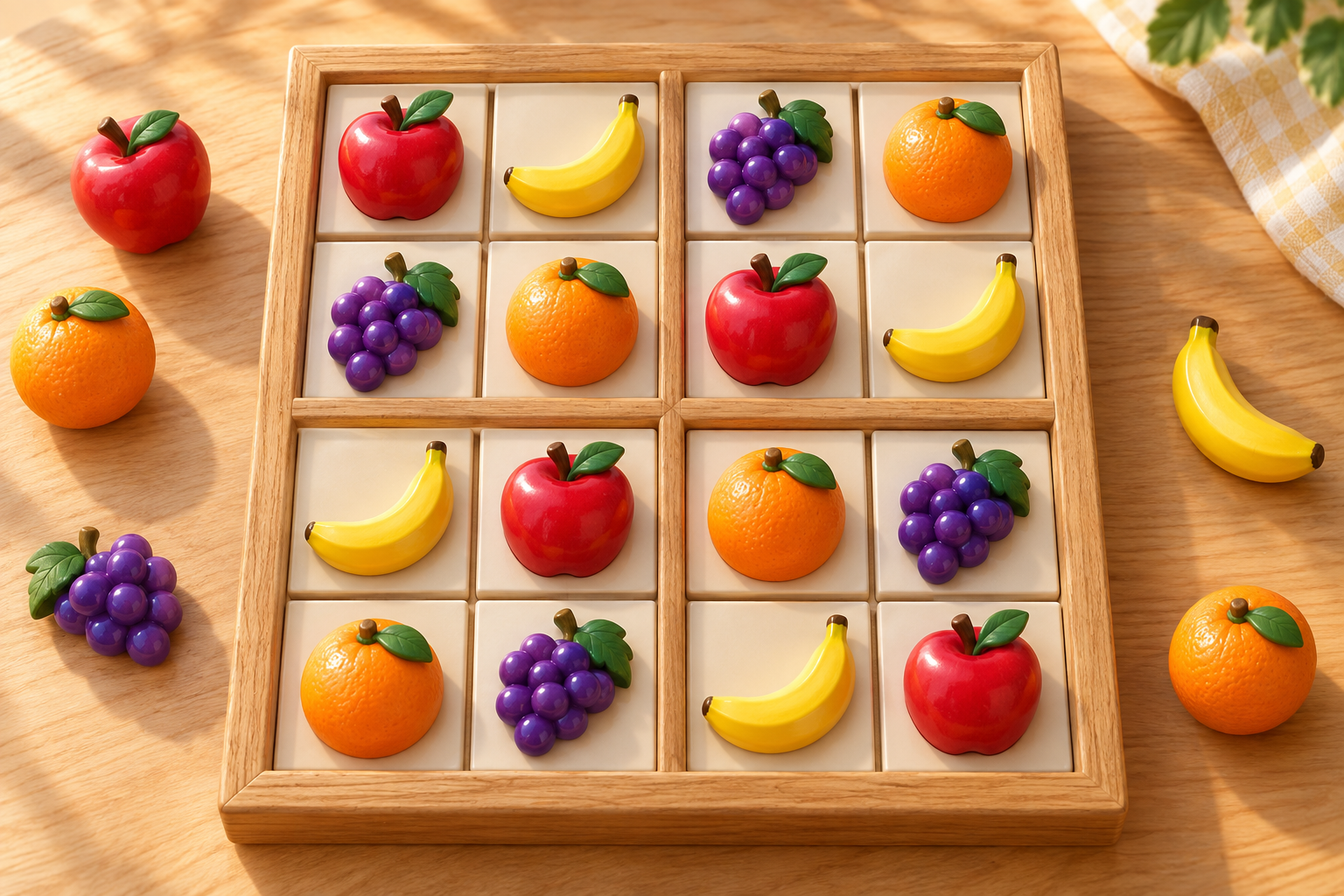
The completed example below has each of the four fruits once in every row, column and 2×2 box. Notice that the long diagonals may repeat a fruit. This is ordinary sudoku, not diagonal sudoku, so a diagonal has no extra rule. Checking the wrong group can make a correct placement seem impossible.

Placing, erasing and checking
Only cells without a given clue accept your input. Select one, then choose a symbol; choosing another fruit replaces your own earlier entry in that cell. Erase cell removes an editable entry. Undo restores the previous board, including a fruit added by a hint. The original clues remain protected through every edit.
The game allows you to place a mistaken fruit so that you can inspect and repair your reasoning. Check highlights duplicates in a row, column or box. It also tells you when locally nonrepeating entries still do not lead to the puzzle's solution. No duplicates is a useful check, but it does not prove that every partial choice is correct.
Do not guess merely because a square looks inviting. If your chosen fruit is already in the same row, column or box, it is ruled out. When several candidates remain, look for another cell with fewer possibilities. A wrong branch can look tidy for several moves before it reaches a contradiction.
What counts as a solution
A solved board is full and obeys all three group rules. Each generated puzzle has one solution consistent with its given clues; the generator checks that before offering the board. The game announces completion only for a full valid board, so putting a picture in every square is not enough by itself.
There is no opponent, winning race or enforced time limit. The completion display reports filled cells and hints. These counters describe your current activity rather than a grade or a published ranking. Fewer clues usually means more work, but the actual deductions also depend on their arrangement. “Fewer clues” is not a certified difficulty rating.
New puzzle changes the clues and clears your entries. Changing size or difficulty also starts a new puzzle. Switching between fruits and numbers preserves the same problem. Leaving or reloading the page loses the current board, so finish a task before navigating away if you want to keep looking at the result.
Three deductions to practise
One gap in a row. In the practice diagram the first row has apple, banana, an empty square and orange. Only grapes are absent from that row. Before placing grapes at C1, check its column and 2×2 box as well. The surrounding clues allow that fruit, so the deduction is consistent with all three groups.
The box eliminates a candidate. In the same puzzle look at A2. Its row is missing grapes and banana. Its column alone does not remove both choices, but the top-left box already contains banana at B1. Therefore A2 must be grapes. Say which group removed banana instead of calling the answer a guess.
Several candidates remain. At C3 in that initial diagram, the row, column and box together still allow banana or orange. Do not choose one simply because it was the last fruit you noticed. Fill a cell with a definite answer first, then revisit C3 after its peers change.
These are deductions about the illustrated puzzle, not instructions to place the same fruit at the same coordinate in every fresh generated board.
A repeatable solving method
Start by scanning for a row, column or box with one empty square. Identify its missing symbol, then confirm the other two groups. If no such group is available, choose an empty cell and list the fruits missing from all three groups at once. A fruit must pass every constraint to remain a candidate.
Work from certain placements outward. One answer can remove a possibility from several neighbouring cells. After placing it, revisit the affected row, column and box instead of scanning the whole board randomly. Keep a paper list of candidates if you want; the online game does not have a pencil-note mode.
If Check finds a repeat, trace both matching symbols and decide which editable placement introduced it. Clues cannot be the entry you change. Undo can help return to the earlier reasoning point. If no repeats are shown but the checker says some entries do not lead to the solution, reconsider choices that had more than one candidate.
The hint explains a single-candidate deduction when one exists. If it reveals an answer from the verified solution instead, it explicitly labels it as an answer hint. Do not treat that reveal as proof that you had eliminated every other candidate yourself.
Paper play and symbol variations
For a paper 4×4 puzzle, use four symbols and draw thicker lines around the 2×2 boxes. Copy the given clues exactly and keep their appearance different from your own entries. The same logic works with numbers, letters or distinct shapes. Changing pictures does not change which groups must avoid repeats.
For 6×6 use six symbols and two-row by three-column boxes. Square 3×3 boxes belong to the usual 9×9 game, not this smaller rectangular version. An accidental change in box shape creates a different puzzle and can make the provided answer unsuitable.
A cooperative home variation lets one person explain a candidate while another checks the three groups. You can also agree to solve without answer hints, using only logical deductions. These are personal challenge rules rather than a separate scoring mode. There are no printable puzzle downloads or saved daily challenge promised on this page.
An independent fruit challenge
Use the practice diagram and explain the first three placements before filling them. Begin with C1: which fruit is missing from the row, and where did you check that the column and box permit it? Then find a cell whose box removes a candidate that its row would otherwise allow.
Next open a new Easy 4×4 puzzle. The fruit at C1 may now be different. Apply the same three-group reasoning instead of copying the example's answer. Try to make three placements without a hint, saying what ruled out the other fruits. If no definite placement is obvious, pick a different cell rather than inventing an answer.
Finally switch the same live puzzle to numbers. Explain why your earlier placements are still valid. Apple is 1, banana 2, grapes 3 and orange 4; only the symbols changed. This transfer checks that you understand the group rule, not just a familiar arrangement of bright pictures.
Controls, hints and keyboard play
Select a cell, then a fruit in the tray. On a keyboard, Tab reaches the board, arrow keys move focus, number keys 1–4 or 1–6 enter the corresponding symbol, and Delete or Backspace clears an editable cell. Accessible labels describe the coordinate, the current fruit and whether it is a given clue.
Check, Undo, Erase cell and Hint are below the board. Hints add one answer and increase the hint count. If your entries conflict or a plausible wrong branch prevents reliable assistance, correct or undo them first. A solved puzzle needs no more hints. There is no sound requirement and no countdown.
JavaScript is required to generate and play puzzles. The article and diagrams work without it. The browser activity is free and needs no registration. Fruit cards in Memory reuse the same illustrations, but there you match two identical pictures; the row, column and box rules belong specifically to sudoku.
Choose fruits, sea animals, space, flowers, classic symbols, numbers, English letters or 3D toys. Changing the theme keeps the puzzle and your entries; only the pictures change. This browser remembers the theme, puzzles started and solved, and the best hint count for each theme, size and difficulty. Solving a puzzle shows a celebration and plays a gentle victory sound, which you can mute. Reduced motion keeps the congratulation visible without confetti.
Open the game →Frequently asked questions
Does fruit sudoku require arithmetic?
No. Fruits are distinct symbols. Each row, column and box must contain each one exactly once.
What board sizes can I choose?
4×4 uses four fruits with 2×2 boxes. 6×6 uses six fruits with boxes two rows high and three columns wide.
Does every puzzle have one solution?
Yes. The generator checks that only one complete solution matches the given clues before play starts.
Can I change a given fruit?
No. Given clues are protected. Your own entries can be replaced, erased or undone.
Does switching to numbers start over?
No. Fruits and numbers represent the same symbols, so switching preserves the puzzle and your entries.
What does Check do?
It marks repeated symbols and reports when some entries without immediate repeats do not lead to the solution.
Does a hint explain the answer?
A single-candidate hint names the only allowed symbol. If no such move is available, an answer reveal is explicitly identified as coming from the verified solution.
Do diagonals need different fruits too?
No. This version checks rows, columns and boxes. Diagonals do not have an additional rule.